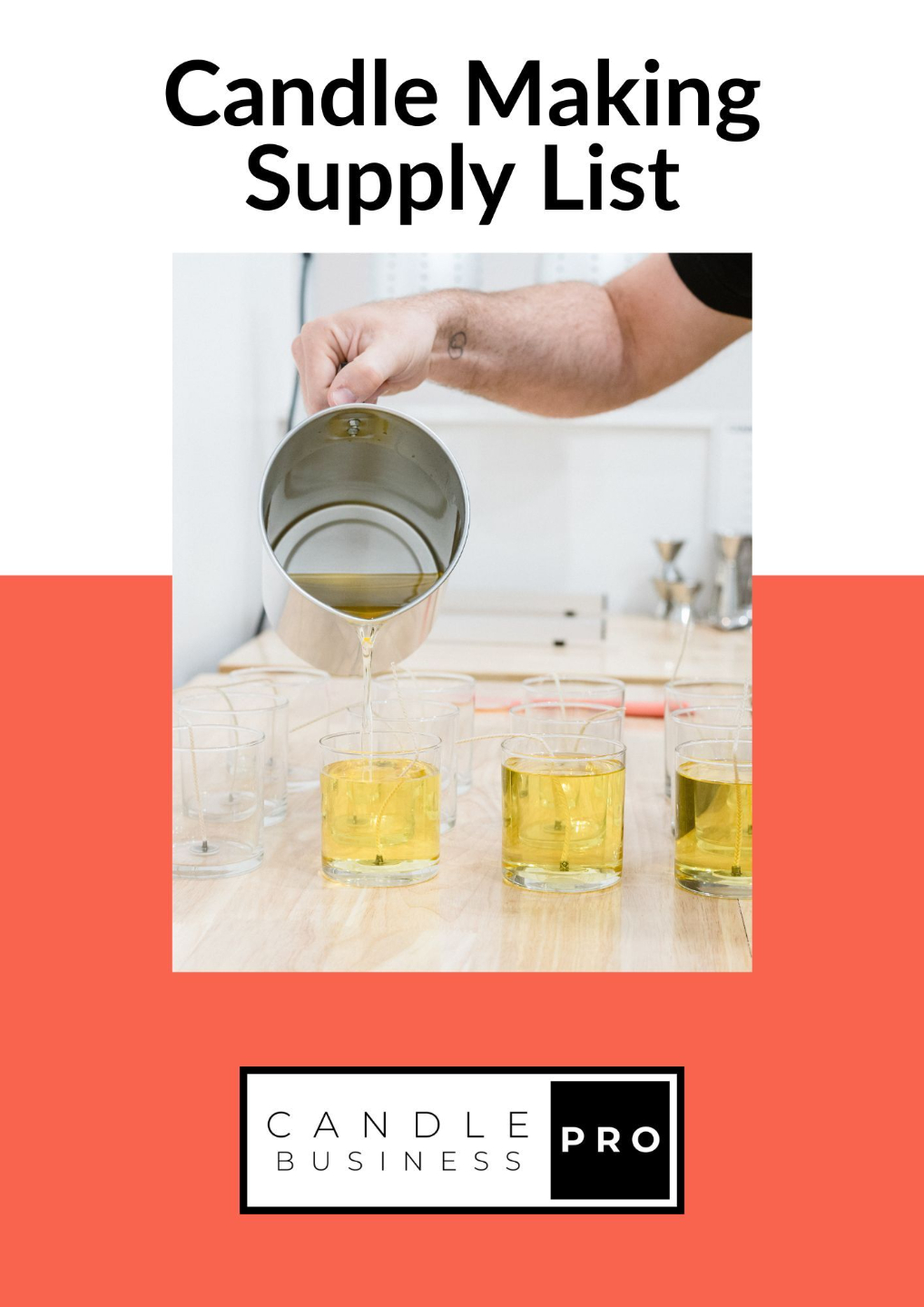
Candle Math Made Simple: How Much Wax and Fragrance You Really Need
Aug 12, 2026When we started Garsnett Beacon Candle Co. at our kitchen table during the pandemic, I wasted more wax to bad math than I want to admit. I would eyeball how much to melt, come up short on the last pour, then melt a second pot and end up with leftover wax hardening in the pot. Multiply that by a few hundred candles and you are literally pouring money down the drain. Once I learned the handful of simple formulas below, my batches got consistent, my costs got predictable, and ordering supplies stopped being a guessing game. If you are figuring out how to start a candle business, this is one of the least glamorous skills to learn and one of the most profitable.
None of this requires you to be good at math. It is mostly multiplication and a kitchen scale. Let me walk you through exactly how we do it.
Step 1: Find your vessel's fill weight with the water test
Every container holds a different amount, and the number printed on the jar (like "8 oz") is almost never the amount of wax it takes. That printed number is fluid ounces, a measure of volume, and wax is lighter than water. So the first thing to do is a water test.
- Put your empty vessel on a scale and zero it out.
- Fill the vessel with water up to the line where you actually want your wax to stop, usually a little below the rim.
- Read the weight of the water in ounces.
That water weight is your starting point, but you do not pour that much wax. Because soy and coconut waxes are less dense than water, your total fill of wax plus fragrance comes out to roughly 80 to 85 percent of the water weight. So if your jar holds 10 ounces of water, your total fill weight is about 8 to 8.5 ounces. I round to 8 ounces and adjust after my first test pour. Do this once per vessel style and write it down. You never have to do it again for that jar.
Step 2: Split your fill into wax and fragrance
Your total fill weight is wax plus fragrance oil combined. Fragrance load is the percentage of fragrance relative to your wax weight. Most soy waxes hold between 6 and 10 percent, and you should always check the max load your specific wax can handle before you go higher.
Here is the clean way to think about it. If your total fill is 8 ounces and you are running an 8 percent fragrance load, do this:
- Wax weight equals total fill divided by 1.08, which is about 7.4 ounces.
- Fragrance weight equals wax weight times 0.08, which is about 0.6 ounces.
- Add them back together and you land at your 8 ounce total.
A shortcut you will hear a lot is "one ounce per pound," which just means 1 ounce of fragrance for every 16 ounces of wax. That works out to about 6.25 percent. It is an easy rule to remember, but running the real percentage gives you a stronger, more consistent scent throw, and consistency is what keeps customers reordering. If you want the exact split without doing the arithmetic by hand, our free candle calculators do it for you.
Step 3: Scale your batch and account for waste
Now that you know the wax and fragrance for one candle, scaling up is just multiplication. Say you want to pour 24 candles at 7.4 ounces of wax each. That is 177.6 ounces of wax, or about 11.1 pounds. Your fragrance at 0.6 ounces each is 14.4 ounces total.
But here is the part beginners forget: you will lose some wax to the pour pot, to spills, and to the little bit that clings to the sides when you empty it. I always add a 10 percent buffer to my melt so I am never short on the final pour. For that 24 candle batch, I would melt closer to 12.2 pounds of wax instead of 11.1. Coming up one candle short at the end of a batch is one of the most frustrating things in this whole craft, and a 10 percent cushion fixes it.
Step 4: Turn it into a shopping list
This is where candle math actually saves you money, because you stop over ordering "just in case" and stop running out mid batch. Let me show you a real example. Say you want to build up inventory of 100 candles in an 8 ounce jar at an 8 percent load:
- Total fill: 100 candles times 8 ounces equals 800 ounces, or 50 pounds combined.
- Wax: about 46 pounds before waste, so order 50 pounds to cover your 10 percent buffer.
- Fragrance: about 3.7 pounds, so I would order 4 pounds to be safe.
- Wicks, jars, lids, and labels: 100 of each, plus a few extras for testing and the occasional cracked jar.
Knowing these numbers before you check out means you buy in the right quantities, which often unlocks better per unit pricing from suppliers, and you are not paying to ship a second emergency wax order two days later. When we were scaling toward our first hundred wholesale accounts, tightening up this ordering process was one of the quiet changes that improved our margins. If you want a full rundown of everything you need to have on hand, our supply checklist lays it out.
Step 5: Recheck your math after real burn tests
Your math gives you a starting point, not a finished recipe. Once you pour and burn test, you might find your fill line looks better a quarter inch higher, or that a fragrance sits better at 9 percent. When you change a number, run the formulas again so your shopping list stays accurate. This is exactly why I keep a simple recipe card for every product with the vessel, the wax weight, the fragrance weight, the wick size, and the cure time. Speaking of curing, give your candles time before you judge the scent, because a rushed burn test will send you chasing problems that were never really there.
Why this matters more than it looks
Candle math is not the fun part of the business. Nobody gets into candles because they love spreadsheets. But this is the difference between a hobby that quietly loses money and a business with predictable costs you can actually price around. When you know your wax and fragrance per candle, you know your cost of goods. When you know your cost of goods, you can price with confidence and take on bigger orders without panicking. Every wholesale order we have ever filled started with knowing these numbers cold.
Start with the water test on your best selling vessel today, write the numbers down, and build from there. If you want to see how we run these calculations in real time, I share a lot of it on our YouTube channel, and if you get stuck on a specific number, come ask in our free Facebook group. There are thousands of makers in there who have solved the exact problem you are working through. And if you are just getting started and want the full roadmap, our 10 step guide walks you through it from the very beginning.
Get the math right, and everything downstream gets easier. I promise it is worth the ten minutes it takes to learn.
Meet The Author