How to Set Up Your Candle Business the Right Way: LLC, EIN, Insurance, and Sales Tax
Aug 07, 2026Everybody wants to talk about wax, wicks, and pretty labels. Nobody wants to talk about the paperwork. I get it. When we started Garsnett Beacon Candle Co. at our kitchen table in Holland, Michigan during the pandemic, the last thing I wanted to think about was an LLC or a sales tax license. I wanted to pour candles and watch them cure. But here is the thing I learned the hard way: the business side is what turns a hobby into an actual company, and getting it set up correctly early saved us a mountain of stress later.
So let me walk you through the four pieces that matter most when you are figuring out how to start a candle business the right way: your business structure, your EIN, your insurance, and your sales tax. I am not a lawyer and I am not an accountant, so please treat this as one candle maker sharing what worked for us, not as legal or tax advice. When in doubt, talk to a professional in your state. But this will give you the lay of the land so you know what questions to even ask.
1. Your Business Structure: Do You Need an LLC?
When you sell your very first candle, you are technically already a business. In most places that default is called a sole proprietorship, and it means you and the business are the same legal thing. That is the simplest way to start, and plenty of makers begin right there while they are testing the waters.
The reason a lot of us eventually form an LLC (a limited liability company) is right there in the name: limited liability. It creates a separation between your personal stuff (your house, your savings) and your business. Candles are a flame product that people burn inside their homes, so that separation matters more in our industry than it does for, say, someone selling stickers.
For us, forming an LLC was the moment the business started to feel real. It was not expensive or complicated. Most states let you file online, and the fee is usually somewhere in the fifty to two hundred dollar range depending on where you live. You will also want to check whether your state or county requires a basic business license or a DBA (doing business as) if you are operating under a brand name that is different from your legal name. Ours is Garsnett Beacon, which is not my legal name, so that step applied to us.
My honest advice: do not let this step paralyze you. You do not need a lawyer to form a simple single member LLC in most states. You can do it yourself in an afternoon. If you want the full picture of where this fits in the launch process, I lay it all out in our free 10 step guide to starting a candle business.
2. Get Your EIN (It Is Free)
An EIN is an Employer Identification Number. Think of it like a Social Security number for your business. Here is the good news: in the United States you can get one directly from the IRS website for free, in about ten minutes. If anyone tries to charge you for an EIN, close the tab. You do not need to pay a third party for it.
Why bother? A few reasons. It lets you open a business bank account without using your personal Social Security number all over the place. Most suppliers who offer wholesale or trade pricing will ask for it. And when you start selling to stores, your wholesale accounts will often want it on file too. We use ours constantly now that we have 160 plus wholesale accounts, but we set it up back when we had exactly zero.
Speaking of bank accounts: open a separate business checking account as soon as you reasonably can. Running every candle sale and every supply purchase through one dedicated account instead of your personal debit card is the single biggest favor you can do for your future self at tax time. It keeps your cost of goods and expenses clean and easy to track, and it makes you look and feel like a real business.
3. Product Liability Insurance: The One People Skip
This is the one I want you to actually pay attention to, because it is the one new makers most often skip, and it is arguably the most important for us specifically. We sell a product that creates an open flame inside people's homes. That is wonderful and cozy and also carries real responsibility.
Product liability insurance protects you if one of your candles is ever blamed for damage or injury. Even if you did everything right, defending yourself costs money, and this coverage is there for exactly that. For a small candle maker, a basic policy is often more affordable than people expect, frequently in the range of a few hundred dollars a year depending on your sales volume and provider.
Here is the practical kicker that surprises new makers: the moment you try to get into wholesale, the stores will require it. Almost every serious boutique, gift shop, and retailer we have ever pitched has asked for a certificate of insurance before they will put our candles on their shelves. So even if you feel like you do not need it while you are selling to friends and at markets, you will need it the day you want to grow into stores. We talk through the whole wholesale readiness checklist, insurance included, in our Wholesale 101 guide.
Two quick habits that pair with insurance and make you far safer either way: put proper warning labels on every candle (the CLP and ASTM safety wording), and keep good burn test records for every product you sell. Documentation is your friend if a question ever comes up.
4. Sales Tax: Collect It, Report It, Move On
Sales tax feels intimidating and it really is not once you understand the shape of it. In most US states, if you sell a physical product to a customer in your state, you are expected to collect sales tax and pass it along to the state. To do that legally you usually register for a sales tax license or permit, sometimes called a seller's permit, through your state's department of revenue or treasury.
That same permit often doubles as your resale certificate, which is the thing that lets you buy your raw supplies (wax, jars, wicks, fragrance) without paying sales tax on them, since you are going to collect the tax on the finished candle instead. That was a nice discovery for us. It felt like leveling up.
A few things to keep straight. First, the platform you sell on matters. Marketplaces like Etsy or Amazon typically collect and remit sales tax for you automatically, while on your own Shopify or website you are usually the one setting it up and staying responsible for it. Second, selling into other states (called nexus rules) can eventually create obligations elsewhere once you get big enough, but do not lose sleep over that on day one. Third, whatever you collect is not your money. Keep it separate in your head, because you will owe it back to the state on your reporting schedule.
My best advice here: once you cross from hobby into consistent sales, spend an hour with a local accountant or bookkeeper who knows your state. It is money well spent, and they will set you up so this runs on autopilot.
The Order We Would Do It In
If I were starting over today, here is roughly the sequence I would follow: decide on your structure and file your LLC if that is your path, grab your free EIN from the IRS, open a dedicated business bank account, register for your state sales tax license so you can also buy supplies tax free, and line up product liability insurance before you pitch your first store. None of it is glamorous. All of it lets you sleep at night and grow without looking over your shoulder.
Do not try to do it all in one day and do not let it stop you from making candles. We built a business with multiple brick and mortar stores and 160 plus wholesale accounts, and we started with none of this figured out. We just handled one piece at a time. You can absolutely do the same.
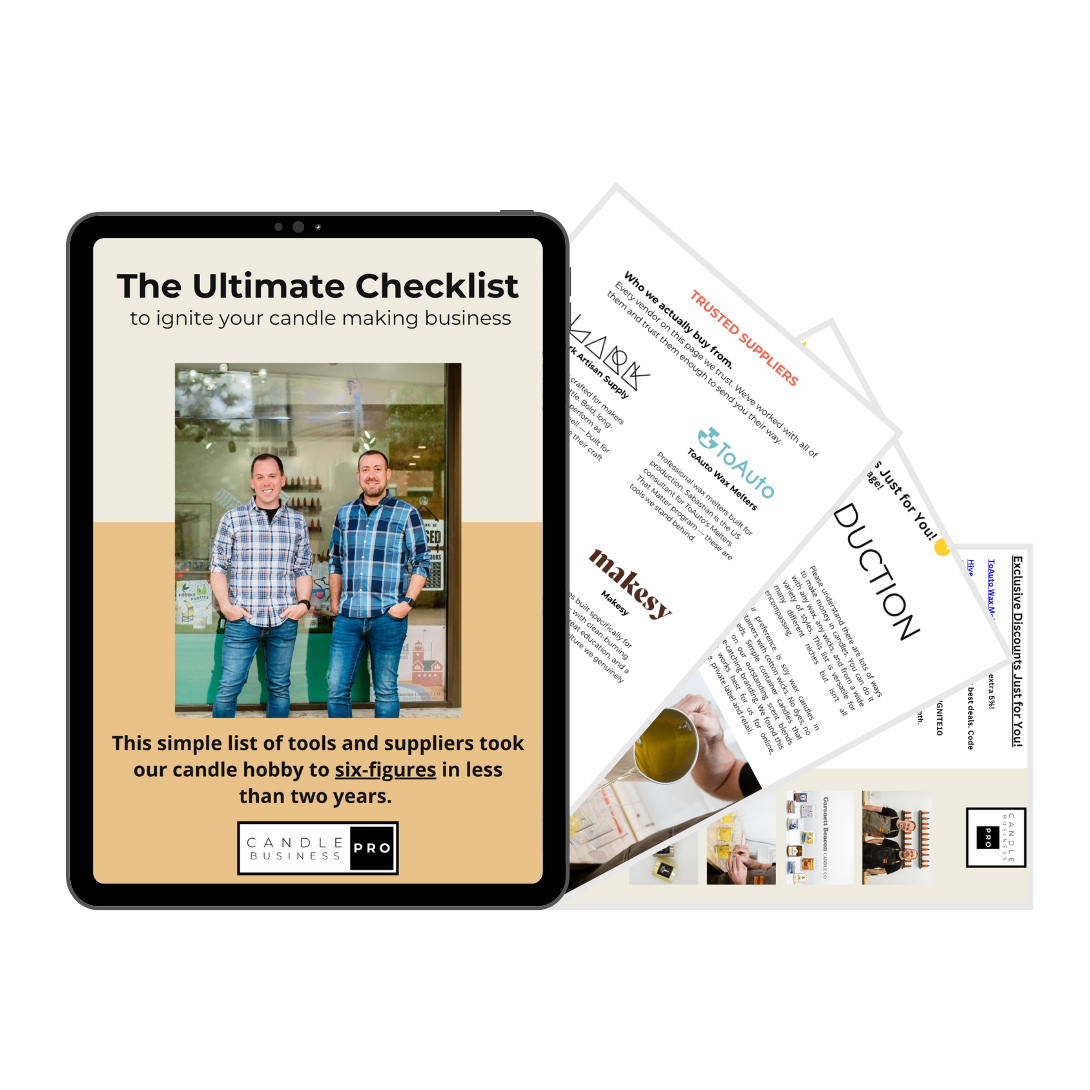
If you want help gathering everything you need to launch, grab our free candle supply checklist, and come hang out with thousands of other makers working through the exact same steps in our free Facebook community. We also break a lot of this down on video over on our YouTube channel. You have got this.
Meet The Author